



- Regulatory Background
- Labeling Requirements
- Licensing and Required Documents
- Import Procedures
- Taxes/Tariffs
- Contacts
REGULATORY BACKGROUND
The Food Safety Standard Authority of India (FSSAI) is the country’s primary regulatory body overseeing food and agricultural imports. The Food Safety and Standards Act of 2006, along with its related regulations, was published in 2011. The Act was followed by the Food Safety and Standards (Alcoholic Beverages Standards) Regulations 2018, which came into effect on April 1, 2019. Imported wine must also comply with the Food Safety and Standards (Import) Regulations of 2017. FSSAI has published a list of FAQs to clarify these regulations.
The Food Safety and Standards (Labelling and Display) Regulations 2020 came into force in November 2021. In June 2019, FSSAI released its 2019 Edition of the Manual for Food Imports, which details the food import clearance process (see Import Procedures below), and in 2024, the agency amended safety requirements for certain imported and domestically food products.
LABELING REQUIREMENTS
The following must be present on all labels of products imported into India in either English or Hindi in the Devanagari Script:
- Name, trade name or description of the product
- Alcohol content expressed as % alcohol by volume or proof
- Volume statement
- Country of origin
- Ingredients, listed in descending order of their quantity
- Residual sugar content (wines only)
- FSSAI logo and license number
- Standard drink information, defined as the amount of beverage that contains 12.7 mL (10 g) of pure ethanol at 20°C. The label may also include a statement indicating the approximate number of standard drinks per package.
- Name and address of the responsible parties (e.g., producer, bottler, importer, marketer)
- Distinctive batch, lot, or code number
- Maximum retail price (MRP) inclusive of taxes, duties, transport, and all other charges
- Date of manufacture or packaging
- “Shelf life or “Best before” date for beverages with an alcohol content of 10% or less
- Storage instructions, if applicable
Health Warning Labeling: The following statutory health warning statement should appear in English or Hindi in the Devanagari Script: “Consumption of Alcohol Is Injurious to Health. Be Safe-Don’t Drink and Drive.” Some States may require this warning to be displayed in their local or regional language. The font size must not be less than 3mm for pack sizes above 200 mL nor less than 1.5 mm for pack sizes of up to 200 mL.
Allergen and Sulfites Labeling: Foods and beverages that contain more than 10 mg/L of Sulphur dioxide must be labeled as “Contains sulphite” or “Contains Sulphur dioxide”. If egg white, isinglass (a clarifying agent), or any other processing aid of animal origin is used in wine, it must be declared on the label along with a non-vegetarian logo. In addition, the following foods and ingredients must be declared separately as “Contains (name of allergen causing ingredients)”: cereals containing gluten; crustacean; milk; egg; fish; peanuts and tree nuts; and soybean.
Genetically Modified Foods: If a product contains more than 1% of any ingredient derived from genetically engineered or genetically modified (GM) crops, the label must include the acronym, “GM”.
Organic Labeling: Foods making organic claims must be certified under either the National Programme for Organic Production (NPOP) or the Participatory Guarantee System for India (PGS-India).
LICENSING AND REQUIRED DOCUMENTS
Before starting any food-related business, importers and food business operators must obtain a License or Registration through FSSAI’s Food Licensing and Registration System (FLRS) online platform. A Central License is mandatory for the importation of food items and is issued by FSSAI regional offices.
The following is a list of documents required when importing into India:
- Import Declaration in the prescribed Bill of Entry format
- Commercial invoice/packing slip
- Freight and insurance certificates
- Import license
- Bill of lading or airway bills
- Certificate of Origin (mandatory for all alcohol beverages). Additional certificates - such as Certificate of Free Sale, Health and Authenticity - may also be required. Please consult TTB’s Export Certificates page for step-by-step guidance on preparing and obtaining export certificates.
- Certificate of Analysis (if required)
- GATT valuation declaration form
Bulk alcohol beverage containers must be labeled with the statement “For Manufacturer of Alcoholic Beverages only”.
IMPORT PROCEDURES
FSSAI has an online system for clearance of food imports – the Food Import Clearance System (FICS) – which is seamlessly integrated with the Indian Customs Electronic Commerce/Electronic Data interchange (EC/EDI) Gateway.
Upon arrival of food consignments at the port, the importer or Custom House Agent must file an Integrated Declaration Form in the prescribed bill-of-entry format, disclosing the value of the imported goods. The bill of entry is filed with India’s Customs via the ICE GATE system and must include the documents listed in the LICENSING AND REQUIRED DOCUMENTS section.
The shipment is then evaluated by the FSSAI for labeling compliance, which includes review of the Certificate of Analysis (if required) and, when deemed necessary, additional laboratory testing. Importers of new products subject to testing may experience delays in product clearance.
The custom clearance period may take between one day to one month, depending on the product and the importer’s experience. When there is a dispute or a shipment rejection, the importer may file an appeal with the Customs office at the port of entry. To facilitate the process, the U.S. exporter is advised to maintain close contact and coordination with their import agents in India.
Trade samples and imports for exhibition purposes are subject to a simplified import procedure. These products can be brought in by the authorized representative as part of their personal baggage or through a courier at the port of entry, provided they are clearly labeled as “Not for Sale” and “For Exhibition Purpose Only”.
FSSAI’s Manual for Food Imports and the accompanying flowchart below provide further details of food import clearance process.
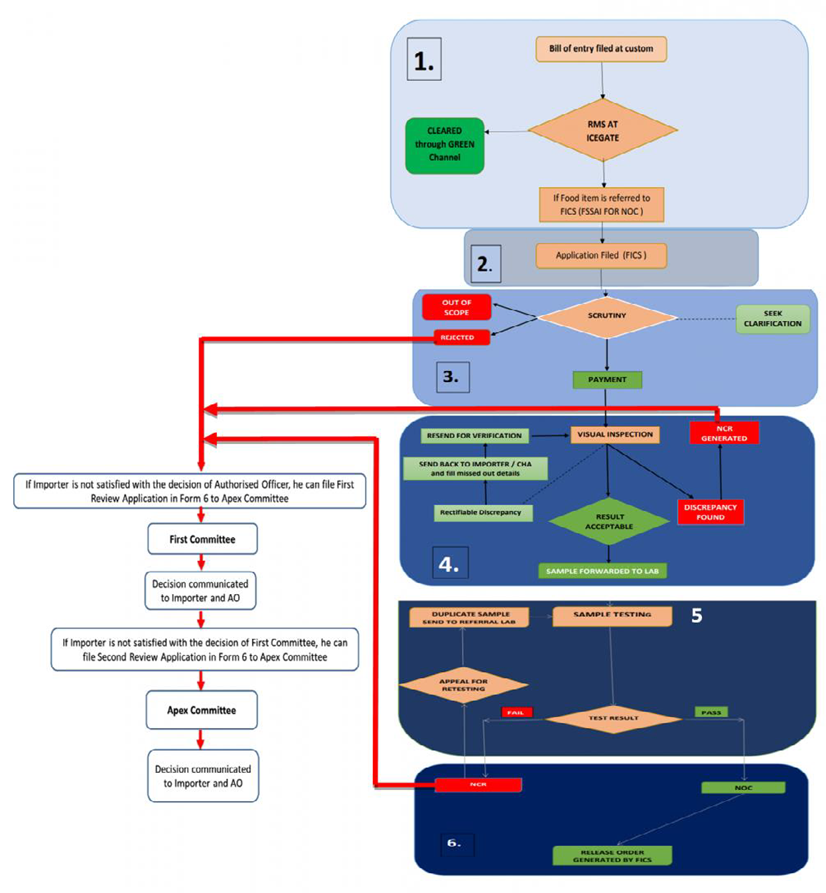
Source: FSSAI
TAXES/TARIFFS
The Indian customs classification on tariff items follows the Harmonized Commodity Description and Coding System (Harmonized System). The Harmonized Tariff Schedule (HTS) number for a specific product can be located using the U.S. Census Bureau's Schedule B search engine or by contacting a commodity expert at the Census Bureau’s Trade Data Collection Branch at: 1-800-549-0595 (option 2). Once the HTS number is obtained, U.S. exporters can use the Customs Info Database to determine import tariffs imposed by a specific country. India’s tariff rates may also be accessed through the WTO Tariff & Trade Data tool. Additional guidance on India’s market access requirements is available from the U.S. International Trade Administration.
Alcohol imports to India are subject to multiple taxes, including import duty tax, social welfare surcharge, and central tax. In addition, each of India’s 28 States and 8 Union Territories maintains its own unique and often complex taxation regime, which include VAT, excise tax, sales tax, and entry of goods tax. Because of this complexity, exporters are strongly advised to verify applicable taxes and other relevant information directly with their local importer.
CONTACTS
| Embassy of India 2107 Massachusetts Ave., NW Washington, D.C. Tel: 202-939-7000 https://www.indianembassyusa.gov.in/ | Ministry of Finance, Department of Revenue Central Board of Excise and Customs North Block, New Delhi – 110 001 Phone: (91-11) 23092849 Fax: (91-11) 23092890 E-mail: chairman@cbec.gov.in https://www.cbic.gov.in/ |
| Food Safety and Standards Authority of India (FSSAI) FDA Bhavan, Kotla Road New Delhi-110 002 Phone: (91-11) 23220991/92 Help desk toll free number: 1800-112-100 E-mail: chairperson@fssai.gov.in http://www.fssai.gov.in/ | Office of Agricultural Affairs Foreign Agricultural Service U.S. Embassy Shantipath, Chanakyapuri New Delhi, 110021 Tel: 91-11-2419-8000 E-mail: agnewdelhi@fas.usda.gov http://in.embassy.gov/ |
| Central Board of Indirect Taxes and Customs Check the website for specific office information https://www.cbic.gov.in/ |
The information in this guide was obtained from external sources, including the websites of various governmental agencies and organizations, direct contact with those agencies and organizations, and from Foreign Agricultural Service (FAS) Attaché reports. Consequently, the accuracy of this information depends upon the accuracy of the sources.
TTB is not responsible for the content of external websites.
This page was last reviewed on December 03, 2025.